

Application: Fluid Dynamics | Surface Interaction | Material Science
Industry: Academia & R&D | Chemical | Biomedical | Meteorology
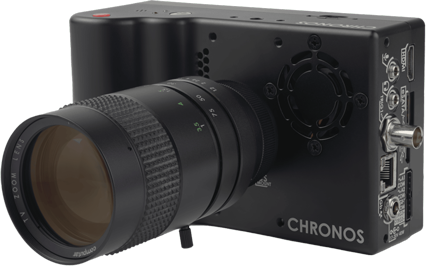
Camera Used: Chronos 1.4
Challenge
Predicting how and where water begins to freeze on hydrophobic plastics - such as polypropylene - has broad implications across atmospheric science, anti-icing materials, and cryopreservation research. Traditional theories suggested that freezing might begin at the flat solid-water interface, but it was unclear which location drives freezing on macroscopic and microscopic plastic surfaces. The gap in understanding made it difficult to design surfaces with controlled ice-formation behavior and to predict how plastic particles could trigger freezing in atmospheric cloud droplets.
Research Team
A research group at University of British Columbia led by Paul Bieber, Teresa M. Seifried, William Bae, Allan K. Bertram, and Nadine Borduas-Dedekind conducted a detailed experimental investigation into this question, published in Langmuir (2025).


High-speed imaging of freezing droplets helped us study the earliest stages of ice formation and uncover the key role of different interfaces. These insights are crucial for designing next-generation anti-freeze and ice-nucleating materials.
Paul Bieber
PHD, UBC
Solution
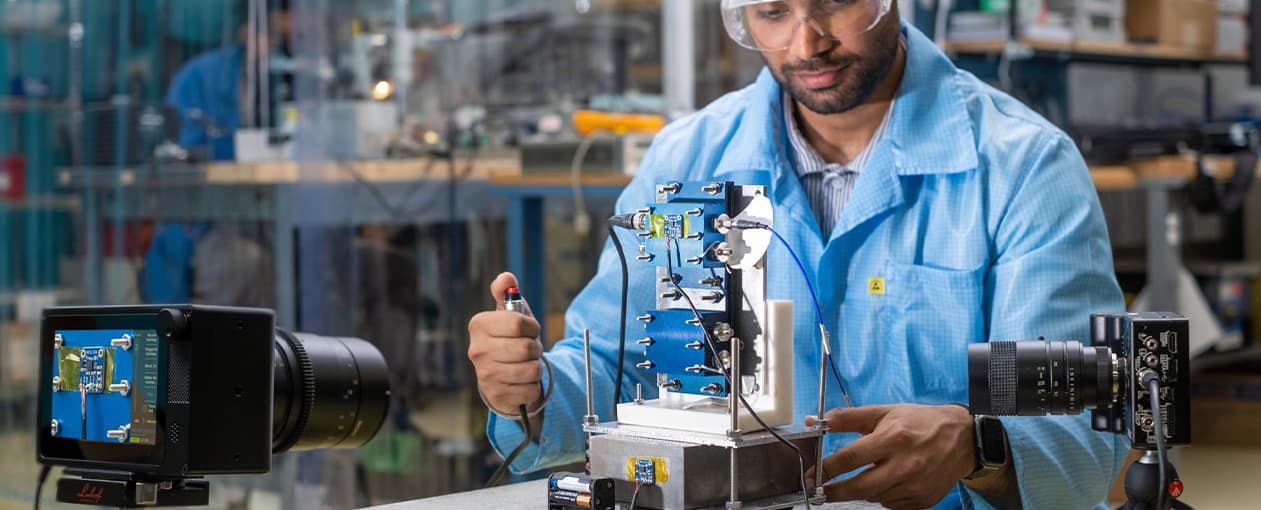
To uncover the dominant freezing mechanism, the team performed controlled cooling experiments with water droplets on both macroscopic polypropylene sheets and microscopic polypropylene fibers under supercooled conditions down to -30 °C. By using the Chronos 1.4 high-speed camera at ≥2100 frames per second, they were able to observe exactly where and how ice nucleation began, differentiating between freezing initiated at:
- The flat water–solid interface
- The three-phase contact line (the perimeter where solid, water, and air meet)
This time-resolved imaging approach provided a unique visual record of the very first moments of ice formation — a phenomenon that occurs too rapidly for conventional observation.

Key Findings
- Ice nucleation overwhelmingly began at the three-phase contact line. For standard 10 µL droplets on polypropylene sheets, contact line nucleation occurred in ~90% of cases.
- In experiments with very small droplets (e.g., ~5 nL) on polypropylene microfibers, ice nucleated at the contact line 3.5 times more often than at the microfiber–water interface.
- Measurements of contact angle during cooling revealed that the contact line remained pinned in place on the plastic surface. A "stuck" contact line might have local pressure fluctuations that influence the onset of freezing.

Summary
High-speed imaging revealed that ice on polypropylene surfaces almost always nucleates at the three-phase contact line - where solid, liquid, and air meet - rather than within the bulk liquid or at the flat interface.
Without high-speed video capture, differentiating nucleation sites would rely on indirect assumptions. By slowing the event down to thousands of frames per second, researchers obtained direct visual confirmation of the freezing origin. This capability is critical for:
- Ice-phobic material engineering for Aircraft and wind turbine applications
- Environmental ice formation modeling
- Understanding cryo-preservation of biological materials
High-speed imaging provides measurable, repeatable insight into ultra-fast interfacial physics events that occur beyond human perception.
Learn how our high-speed cameras can reveal ultra-fast phenomena in your research or engineering projects.
Share
About
Team: University of British Columbia
Camera: Chronos 1.4 High-Speed Camera
Industry
Applications

More Case Studies
Aerospace


SaaS
Kron Technologies Streamlines Sales with Katana and WooCommerce
Kron Technologies is the manufacturer of high-speed cameras and uses seamless Katana and WooCommerce integration to streamline…
Research
Plasma Research University of Saskatchewan
Case Highlights: Customer: University of Saskatchewan Use Case: Research & Development Needs: Observe plasma spokes Challenge: Observing…